


What a Special Needs Trust in Singapore Actually Does


A Special Needs Trust with the Special Needs Trust Company (SNTC) holds money for your dependent with disabilities, guarantees the principal you deposit, and pays it out according to instructions you write in a Letter of Intent, managed through a personalized Care Plan. You open an account with a minimum deposit of S$5,000, and subsidies or sponsorships can lower what you pay out of pocket. Your next move is straightforward:
Contact SG Enable or SNTC to start an intake conversation.
Get a Disability Verification Form completed by a registered healthcare professional.
Ask about MSF fee subsidies and GOAL/GOAL+ sponsorship before you assume the cost is out of reach.
Key Takeaways
Setting up income protection for a dependent with disabilities in Singapore works best when caregivers combine a free CPF nomination with an actively managed, government-backed trust.
Point | Details |
Start with SNSS | Nominate the CPF Special Needs Savings Scheme first since it costs nothing and creates a guaranteed income floor. |
Open an SNT account early | The S$5,000 minimum deposit and MSF subsidy make it possible to start before full funding is secured. |
Bring complete documents to intake | A signed Disability Verification Form, NRICs, and medical reports speed up the SNTC process significantly. |
Update your will and insurance | Route insurance payouts and estate proceeds to the trust by naming it as a beneficiary. |
Get bespoke help for complex estates | Elitelegacyplanning’s trust consultation service coordinates wills and private trust structures for property or business assets that SNTC cannot accept directly. |
Table of Contents
What Are the Special Needs Trust and SNTC in Singapore?
SNTC is a not-for-profit trust company and registered charity, operating as a subsidiary of SG Enable, built specifically to hold and manage money for people with disabilities after their caregivers can no longer do it themselves. The Public Trustee’s Office holds and invests the underlying funds, and the government guarantees your principal deposit. That guarantee is the whole point: your money doesn’t ride the market the way it might in a private investment account.
Each family gets an SG Enable case manager who builds a personalized Care Plan and oversees disbursements according to your Letter of Intent, a service MSF has documented as core to SNTC’s welfare mandate, not just its financial one.
The reason this beats handing over a lump sum: a lump-sum inheritance to someone who can’t manage money independently, or who is vulnerable to financial abuse, can vanish fast. SNTC controls the tap.
Principal is government-guaranteed.
A named case manager tracks spending against your Care Plan.
Reviews and home visits continue for as long as the trust operates.
Who Qualifies and What Should You Bring to Intake?
Eligibility rules aren’t complicated, but they’re specific. Your dependent needs to be a Singapore citizen or permanent resident, or otherwise residing in Singapore, and a Disability Verification Form signed by a registered healthcare professional confirms the disability. Caregivers face their own basic checks: age, mental capacity, and bankruptcy status all matter, since you’re the one setting up and often co-managing the account.
Before your intake meeting, gather these:
The completed Disability Verification Form (DVF).
NRICs for both the caregiver and the beneficiary.
Recent medical reports supporting the disability diagnosis.
Insurance policy numbers for any policies you plan to route into the trust.
Details of your existing will, if you have one, including any current beneficiary nominations.
Walking in with this ready cuts weeks off the process. Case managers can’t build a meaningful Care Plan on incomplete information, and incomplete files are the single biggest reason first meetings turn into second meetings.
How Do You Set Up an SNT Account, and What Does It Cost?
The path from first phone call to an active trust follows a predictable sequence:
Contact SG Enable or SNTC directly for an intake session.
Submit your Disability Verification Form.
Open the SNT account with the minimum deposit of S$5,000.
Draft your Letter of Intent with your case manager, spelling out how funds should be spent.
Nominate the trust as a beneficiary on relevant CPF accounts, insurance policies, and your will.
On cost: setup and administration fees exist, but they’re rarely paid in full by most families. MSF subsidizes SNTC fees, historically covering 90 to 100 percent for eligible households, and Community Chest activation capital and the GOAL and GOAL+ matching grant schemes have helped families without a large lump sum to open an account sooner.
Timelines vary by case complexity and how quickly documentation comes together, but sponsorship and subsidy applications typically run alongside your intake rather than delaying it.
Pro Tip: Don’t wait until you have full funding to start. Practitioners commonly recommend opening the account at the S$5,000 minimum and drafting your Letter of Intent early, then routing larger sums later through your will or insurance payout once those documents are updated.

How Do CPF SNSS, Insurance, and Wills Fund the Trust?
The Special Needs Savings Scheme (SNSS) and SNTC solve different problems, and most families in Singapore end up using both. SNSS is a CPF nomination that pays your dependent a monthly amount once you pass away or lose mental capacity. It costs nothing to set up and requires no ongoing management.
SNTC, by contrast, is an active trust with a human case manager who adjusts spending as circumstances change and files periodic reviews.
SNSS gives you a guaranteed income floor with zero setup cost.
SNTC gives you flexible, case-managed spending that can respond to a changing situation.
You can nominate SNSS through your CPF account directly, and separately name SNTC as a beneficiary on insurance policies and in your will.
Practitioner guidance from Special Ed Start Guide recommends pairing both rather than choosing one over the other.
The catch with SNSS: it stops paying once the CPF balance runs out. SNTC doesn’t have that hard stop in the same way, because it can be topped up over time and adapts disbursement to actual need rather than a fixed monthly figure. Check your existing beneficiary designations now. Many caregivers assume an old will or policy already routes funds correctly, and it often doesn’t.
What Happens When the Trust Activates?
Activation happens when the caregiver dies or loses mental capacity, and it triggers a defined sequence rather than an automatic payout. SG Enable and SNTC case managers conduct a home visit and needs assessment before disbursements begin, then activate monthly or periodic payments according to the Letter of Intent you drafted years earlier.
Your Letter of Intent becomes the operating manual for how money gets spent.
The case manager coordinates with executors, insurers, and any other parties handling your estate.
Reviews continue on a regular schedule, not just once at activation.
If a beneficiary’s needs change, the Care Plan can adjust rather than staying frozen to what you wrote originally.
If funds run low, SNTC connects beneficiaries to community support programs rather than simply closing the account. That safety net matters more than most caregivers realize until they’re actually relying on it.
When Does a Private Trust Make More Sense Than SNTC?
SNTC accepts cash contributions only; property, shares, and other non-cash assets need to be liquidated first, usually through a will, before proceeds can enter an SNT account. If your estate is mostly property or a business stake, that’s a real constraint.
A private trust or bespoke estate structure can hold non-cash assets directly, offer tailored investment strategies, and accommodate more complex succession rules than a standardized government-backed vehicle allows. The tradeoff is that private trusts don’t carry SNTC’s principal guarantee, and investment performance depends on how the trust is structured and managed.
Complex or illiquid estates often need bespoke drafting, not a standard trust template.
Private structures can name multiple contingent beneficiaries and unusual conditions SNTC doesn’t accommodate.
Elitelegacyplanning’s trust consultation and lifetime advisory service works alongside SNTC or SNSS rather than replacing them, coordinating wills, insurance nominations, and a private trust company structure where one makes sense.
Pro Tip: If a chunk of your estate is property, don’t leave the liquidation question until after you’re gone. Coordinate the will language now with whoever is drafting it.
Authoritative Singapore Links to Start the Process
SG Enable: Special Needs Trust for intake and case manager contact.
CPF SNSS nomination page for setup.
MSF’s overview of SNTC’s welfare oversight role.
ScamShield to verify contacts before transferring any funds.
Why the Standard Advice Undersells the Two-Track Approach
Most guidance on this topic treats SNSS and SNTC as competing choices, and that framing does families a disservice. They solve different problems. SNSS is free and automatic; SNTC is managed and adaptable. Caregivers who wait to “decide” between them often end up doing neither for years, which is the worst outcome of the three.
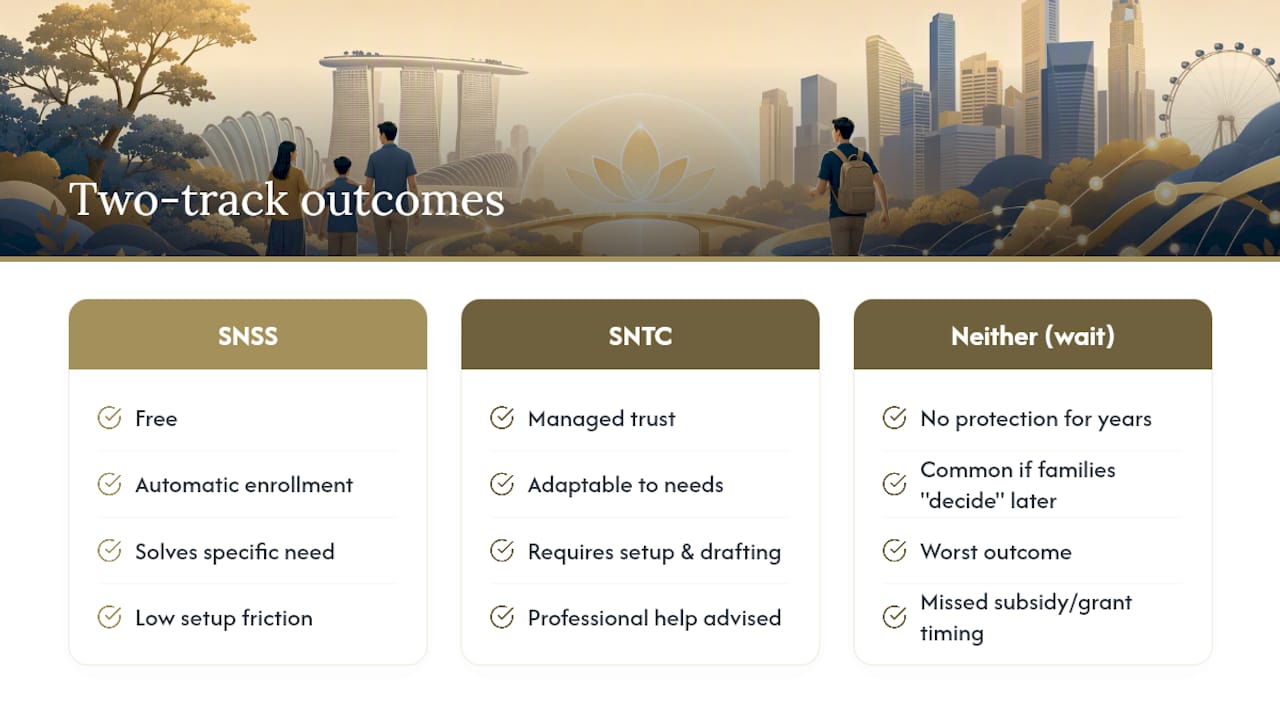
What’s underrated is timing. The subsidy and grant environment, particularly Community Chest activation capital and the GOAL+ matching grant, has shifted the calculus for families who assumed a trust was only for households with substantial savings. That assumption is now outdated, and holding off on intake because you think you can’t afford it costs you the years a Letter of Intent should have been maturing.
Where I’d push back hardest on conventional wisdom: don’t treat the will as an afterthought once the trust is open. The families who run into trouble are usually the ones whose insurance and will language never got updated to actually point at the trust they set up. That’s a drafting problem, not a trust problem, and it’s exactly where professional help earns its cost.
— Joseph
Get Bespoke Support Coordinating Your Trust and Estate Plan
SNTC and SNSS cover the government-backed foundation well, but they can’t draft your will, restructure property held outside CPF, or build a private trust around a business you own. Elitelegacyplanning fills that gap: coordinating your will, insurance nominations, and CPF designations so they actually point at the structures you’ve set up, instead of leaving gaps that surface only after you’re gone.

If your estate includes property, investments, or a business interest that SNTC can’t accept directly, our trust consultation and lifetime advisory service walks through how a private trust company or comprehensive will fits alongside what you’ve already started with SNTC. Book a consultation through our online booking page to review your current beneficiary nominations and close the gaps before they become a problem for the person you’re planning for.
Sources
Recommended
Comments