


Avoid Delay: Probate vs Letters of Administration in Singapore for HNW


If the deceased left a valid will naming an executor who is willing and able to act, that executor applies for a Grant of Probate. If there’s no valid will, or if no executor is available to act, someone with priority under the law applies for a Grant of Letters of Administration instead. The Family Justice Courts issue both as electronic grants once the paperwork clears.
TL;DR:
Filing the correct form depends on whether there is a valid will with an available executor or if no executor exists, which requires an application for Letters of Administration.
Accurate valuation of all assets on Schedule of Assets (Form 177) is critical, as errors can delay the process or cause estates to be filed in the wrong court.
Applicants for Letters of Administration must follow a strict priority order, with the surviving spouse, children, and then other relatives, while probate is limited to the named executor.
Complex estates, especially those involving cross-border assets or corporate shares, often need professional guidance to avoid jurisdiction issues and administrative delays.
Most errors stem from incorrect asset valuations rather than legal disputes, highlighting the importance of thorough asset documentation before submitting court forms.
Table of Contents
Probate vs Letters of Administration: The Legal Difference
A Grant of Probate confirms a will is valid and formally authorizes the named executor to collect assets, settle debts, and distribute the estate. It only applies when there’s a will and the named executor is alive, of sound mind, and willing to serve.
A Grant of Letters of Administration covers everything else. That includes true intestacy (no will at all) and a less obvious scenario: a valid will exists, but no executor is named, or the named executor has died, refuses to act, or renounces the role. Courts call this second case “letters of administration with will annexed,” and it’s easy to miss if you assume any will automatically means probate.
Both grants trace back to the Probate and Administration Act 1934, which sets the statutory definitions courts still apply. Where there’s no will, the Intestate Succession Act dictates who inherits and in what shares, which in turn determines who has priority to administer.
Two quick scenarios illustrate the split:
A father dies with a signed will naming his eldest son as executor. The son applies for Grant of Probate.
A mother dies without a will. Her husband and adult children apply for Grant of Letters of Administration, with the surviving spouse typically taking priority to apply.
Who Can Apply, and in What Order
For probate, the answer is straightforward: the executor (or executors) named in the will applies. If there are multiple executors, they can apply jointly, or one can apply while reserving power to the others. A named executor who doesn’t want the role can formally step aside using Form 166, which lets someone else in the priority chain take over.
Letters of administration works differently because there’s no named applicant. Priority follows a set order:
Surviving spouse
Children (or their descendants if a child has died)
Parents of the deceased
Siblings, then more distant relatives, in descending order
An applicant must be at least 21 years old and of sound mind. Where someone higher in priority declines, they generally need to renounce formally before the next person in line can apply.
Applying for a Grant of Probate: The Practical Checklist
Start by checking your eligibility for the Probate eService, which lets an eligible sole executor prepare and file documents directly. If the estate is complex, involves multiple executors, or you’re not comfortable navigating court forms, the Service Bureau or a lawyer becomes the more practical route.
Gather core documents: the original will, the death certificate, and a complete Schedule of Assets (Form 177) listing every asset and its value.
Prepare the Supporting Affidavit and Administration Oath, which confirm the will’s validity and your commitment to administer the estate properly.
File the application, then submit the supporting documents within 14 days.
Wait for court review. If everything checks out before the hearing date, the court may approve the application without requiring attendance.
Receive the electronic grant, then request certified copies for banks and other institutions.
Pro Tip: Undervaluing or omitting an asset on Form 177, even by accident, is the single most common reason applications stall. Double-check every bank account, insurance policy, and property title before filing.
Applying for Letters of Administration: The Practical Checklist
This process applies mainly to beneficiaries filing after an intestate death, and timing matters more here than in probate cases. Many applicants are expected to move within six months of the death where possible, particularly when other beneficiaries are waiting on distribution.
Search court records for existing caveats or pending applications before you file, since only one valid grant can exist for an estate at a time.
Complete the Schedule of Assets (Form 177) with the same rigor probate applicants use, since it drives the court’s assessment of the estate’s value.
Determine whether an administration bond is required. Courts sometimes require this as security, particularly when minors or vulnerable beneficiaries are involved.
Confirm jurisdiction. Straightforward estates typically go through the Family Courts, while larger or more complex ones fall under the Family Division of the High Court.
File the Originating Application along with supporting affidavits, then respond to any queries the court raises before the grant is issued.
Forms, Timelines, and Costs: The Filing Details That Trip People Up
Both processes share a common paper trail: Form 177 (Schedule of Assets), a Supporting Affidavit, an Administration Oath, and, for anyone stepping aside, Form 166. Getting these right the first time saves weeks.
Supporting documents are due within 14 days of filing the initial application.
A hearing is only required when the paperwork raises questions or a dispute exists; otherwise, the court can approve on the papers.
Filing jurisdiction hinges on estate value under current Practice Directions: smaller, uncontested estates are handled by the Family Courts, while larger estates move to the Family Division of the High Court.
Most banks and financial institutions require a court grant to release funds from estate accounts, especially for sums exceeding certain modest thresholds. That single operational rule is why so many families end up filing even when the estate feels modest.
Where Applications Go Wrong: Caveats and Disputes
The most frequent snag isn’t a legal dispute. It’s an inaccurate Schedule of Assets, whether from a missed property, an outdated valuation, or a joint account left off the form. That single error can push an estate into the wrong court or trigger delays while the figures get sorted out.
Caveats add another layer. A caveat blocks a grant from being issued until the concern behind it is resolved, which is why applicants search the register before filing rather than after.
Always search for caveats before you file, not after.
Treat any family disagreement over who should administer the estate as a signal to get legal advice early.
Pro Tip: If you sense a sibling or relative might contest who administers the estate, resolve it before filing rather than after. A contested application can add months to a process that otherwise takes weeks.
When You Might Not Need a Grant at All
Not every estate needs a court order. For very small or simple estates, the Public Trustee may step in, or banks may release modest sums directly without a formal grant.
Even so, secure the death certificate, notify banks and insurers early, and start compiling the Schedule of Assets immediately. Run a caveat search before deciding whether a workaround will actually save time, since larger institutions often insist on a grant regardless.
When HNW Estates Need More Than a Standard Application
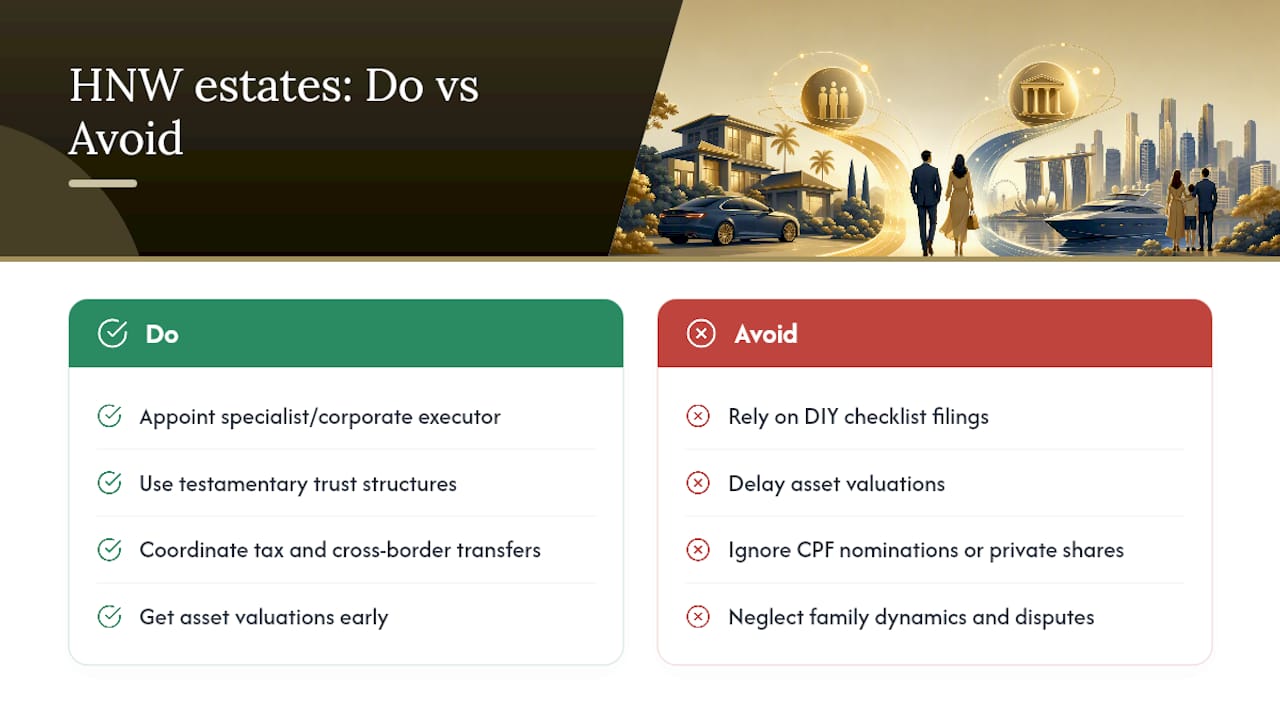
Straightforward checklists work fine for modest estates. They tend to break down fast for high-net-worth families holding cross-border property, private company shares, CPF nominations, and testamentary trust arrangements layered across generations.
Corporate executorship exists precisely because individual executors can get overwhelmed by tax coordination, cross-jurisdiction asset transfers, and family dynamics happening at the same time. A specialist executor or trust structure can prevent the administrative gridlock that stalls simpler DIY filings, and often catches valuation issues in the Schedule of Assets before they become jurisdiction problems.
What Most Guides Get Wrong About This Decision
Most explainers treat probate and letters of administration as a binary choice: will or no will, done. That framing misses the messier middle ground, wills with no willing executor, joint executors who disagree, estates that straddle two court thresholds, where the real delays happen.
The research here points to one practical truth: the Schedule of Assets is the single document most likely to derail an otherwise simple application. Get the valuations wrong, and you don’t just slow things down. You can accidentally push a modest estate into the wrong court entirely.
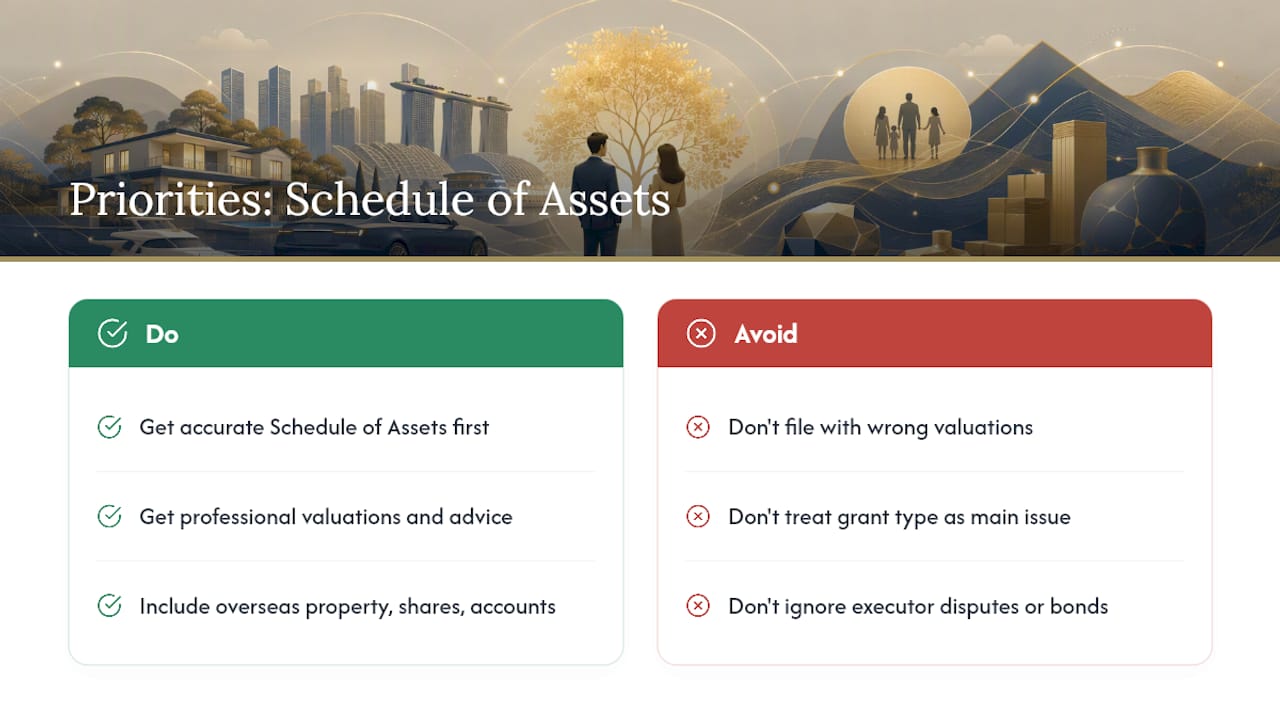
My take is that families overinvest effort in figuring out “which grant” and underinvest in getting the numbers right before they file. The grant type usually resolves itself once you know whether a valid will exists. The valuation, the jurisdiction call, the bond requirement, that’s where professional input earns its cost, especially once an estate includes property, company shares, or accounts held outside Singapore.
If there’s one thing to prioritize first, it’s this: get an accurate, complete Schedule of Assets before you touch a court form. Everything downstream depends on it.
— Joseph
How Elite Legacy Planning Supports Probate and Administration Cases
Elite Legacy Planning gives HNW families a structured alternative to piecing together a probate or administration filing on their own, particularly when the estate includes property, private company shares, or accounts spread across more than one country.

Where a straightforward DIY filing through the Probate eService works fine for a simple, single-asset estate, complexity changes the math fast. Elite Legacy Planning helps with Schedule of Assets preparation, corporate executorship, and living or private trust structures designed to keep an estate out of administrative gridlock in the first place. For families who’d rather set up a Standby or Living Trust now than leave beneficiaries navigating letters of administration later, that’s often the more durable route.
Review the full range of estate planning and probate support services, then book a consultation to talk through your specific situation before you file.
This article is general information, not a substitute for advice from a qualified lawyer. Consult a qualified legal professional about your own circumstances before acting on anything here.
Sources
Recommended
Comments