


Inheritance Tax Singapore: What Residents and Executors Should Know


Singapore has no inheritance tax. Estate duty, the tax that once applied to a deceased person’s estate, was abolished for every death occurring on or after February 15, 2008, according to IRAS. If your family member died on or after that date, there’s nothing to file and nothing owed on the inheritance itself.
If the death happened before February 15, 2008, the old rules may still apply, and you should check IRAS guidance or speak with a specialist before assuming otherwise.
Death on or after February 15, 2008: no estate duty, no clearance needed.
Death before February 15, 2008: old estate duty rules may still apply. Confirm the exact date and check with IRAS or a private legal advisor.
Quick fact: PwC’s tax summary independently confirms the same cutoff, which matters if you’re trying to verify this against more than one source.
Key Takeaways
Singapore abolished estate duty for all deaths on or after February 15, 2008, so no inheritance tax applies today, though pre-2008 estates may still require historic clearance procedures.
Point | Details |
No current inheritance tax | Estate duty was abolished for deaths on or after February 15, 2008, per IRAS. |
Pre-2008 deaths need checking | Estates from before that date may still require clearance, forms, and valuation work. |
Domicile and asset type matter | Domicile status and whether assets sat in Singapore determined historic duty exposure. |
CPF sits outside the will | CPF balances pass through nomination, not probate, so a will alone doesn’t cover them. |
Planning still matters | Wills, CPF nominations, and trusts prevent delays and disputes even with no estate tax. |
Table of Contents
What Was Estate Duty, and Why Did Singapore Scrap It?
Estate duty was a tax levied on the total market value of a deceased person’s assets, assessed as of the date of death. It functioned much like inheritance taxes in other countries: the government took a cut before the estate passed to heirs, with the size of that cut depending on the estate’s value and the deceased’s domicile status.
The rules changed twice before disappearing entirely. Before January 1, 2002, estate duty applied more broadly, covering a wider range of assets and domicile scenarios. From January 1, 2002, to February 14, 2008, the government narrowed the scope and introduced higher exemption thresholds, softening the burden on middle-class estates while still taxing larger ones. Then, in Budget 2008, the government abolished it outright.
The rationale, as summarized across IRAS materials and professional tax guidance, centered on competitiveness: estate duty raised relatively little revenue while pushing wealthy individuals and their capital toward jurisdictions with no such tax. Removing it kept Singapore attractive for wealth to stay, and for global capital to arrive.
Here’s the timeline in short form:
Pre January 1, 2002: Broader estate duty rules, lower exemption thresholds, wider asset coverage.
January 1, 2002 to February 14, 2008: Narrower scope, higher exemptions, but duty still applied.
February 15, 2008 onward: No estate duty of any kind, per IRAS.
Singapore joins Hong Kong, Australia, and several other jurisdictions that dropped estate-level taxation decades ago, largely for the same competitive reasons.
Which Deaths and Assets Still Fall Under the Old Rules?
The date of death is everything. It decides whether an estate owes anything at all, and if it does, which version of the rules applies.
Before January 1, 2002: Full estate duty rules apply, including older thresholds and broader asset coverage.
January 1, 2002 to February 14, 2008: Estate duty applies under the revised, higher-threshold regime.
On or after February 15, 2008: No estate duty whatsoever, regardless of estate size or asset type.
Domicile matters almost as much as the date. A person domiciled in Singapore at death had their worldwide movable assets and Singapore immovable property assessed for duty (for deaths before the cutoff). A non-domiciled person was generally only assessed on Singapore-situated assets. In practice, this meant a wealthy expatriate who died in, say, 2005 while domiciled overseas often faced a smaller Singapore duty bill than a long-term Singapore-domiciled resident with the same total wealth, because only the local assets counted.
Asset treatment varied too. Singapore immovable property and most movable assets held locally fell within scope for pre-2008 deaths. Immovable property located outside Singapore generally didn’t, regardless of domicile. Jointly held assets were assessed based on the deceased’s proportionate contribution rather than a blanket 50/50 split, and CPF balances had their own aggregation rules feeding into the exemption calculation, both detailed in IRAS’s estate duty FAQs.
Pro Tip: If you’re unsure whether a relative’s death falls before or after the cutoff, check the exact date on the death certificate first. A few days on either side of February 15, 2008, changes everything about what you owe and what paperwork you need.
How Was Estate Duty Actually Calculated Before 2008?
For deaths before February 15, 2008, the calculation started with total taxable asset value, then subtracted specific exemptions before applying tax rates.
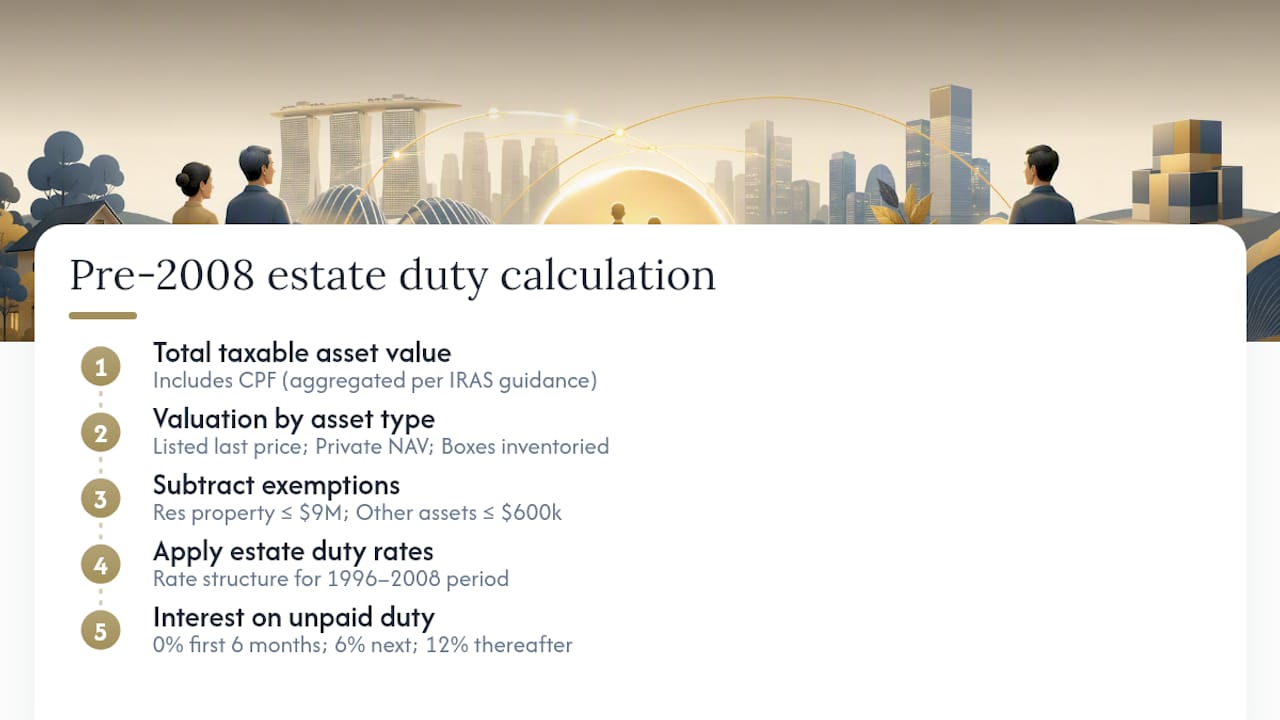
Two exemption thresholds mattered most. Residential property received an exemption of up to $9 million, while other dutiable assets carried a $600,000 exemption threshold, per IRAS’s calculation guidance. CPF balances had their own aggregation treatment that fed into whichever exemption applied.
For deaths between February 28, 1996, and February 14, 2008, the rate structure was:
Valuation methods depended on asset type. Listed shares were typically valued at the last-done price on the date of death. Private company shares required a more involved valuation, often based on audited accounts and net asset value, since there’s no public market price to reference. Safe-deposit box contents had to be inventoried and valued individually, which frequently meant banks required an inspection before releasing the box to the executor.
Interest on unpaid duty followed a stepped schedule: no interest for the first six months after death, 6% annually for the following period, then 12% once the delay stretched further, according to IRAS. Executors handling legacy pre-2008 cases today still need to account for this if a filing was ever delayed or disputed.
What Should Executors Do First?
Handling an estate today, whether it’s a fresh case or an old one resurfacing through a property sale or bank account closure, follows a fairly predictable sequence.
Confirm the exact date of death. This single fact determines whether estate duty applies at all.
Check if estate duty clearance is required. Deaths on or after February 15, 2008, need none. Earlier deaths may still require clearance from the Commissioner of Estate Duties before assets can be distributed.
Gather a full asset list and valuations. Include property, bank accounts, CPF balances, insurance proceeds, shares, and any overseas holdings.
Determine whether a Grant of Representation is needed. The Family Justice Courts handle applications for a Grant of Probate (where there’s a will) or Letters of Administration (where there isn’t one).
Submit the right forms, if applicable. For pre-2008 estates, this can include Form ED (the Estate Duty Return), the relevant Forms SC, the Observations Form, and a Schedule of Immovable Property, all directed to the Commissioner of Estate Duties per IRAS.
A few practical notes worth flagging:
Historic filings often carried a six-month window before interest started accruing, so check whether that clock already ran out on an old case.
CPF balances are handled separately from the general estate through the CPF Board’s nomination system, not through probate.
Get a lawyer involved early if the estate includes overseas property, a private company, contested claims among beneficiaries, or any pre-2008 death where records are incomplete. These cases turn into document-heavy reconciliation work fast, and a professional administrator saves time that grieving families often don’t have.
Estate Planning Without an Inheritance Tax: What Actually Matters Now
With no estate duty to plan around, Singapore estate planning shifts from tax minimization to something more fundamental: making sure assets reach the right people, quickly, without a court fight.
A will remains the foundation. It names an executor, states who gets what, and avoids the default distribution rules under intestacy law, which rarely match what a family actually wants. Elite Legacy Planning’s comprehensive will drafting service covers this as a baseline for most clients.
CPF nominations operate entirely outside the will. Without one, CPF savings go through the Public Trustee’s default distribution scheme regardless of what the will says, which surprises a lot of people. This is one gap a general will can’t close.
For larger or more complicated holdings, a living trust or private trust company provides continuity a will alone can’t. Assets placed in a properly structured trust bypass probate entirely, which matters most for property portfolios, business interests, or families spread across multiple countries. Elite Legacy Planning’s standby and living trust structures and property trust services are built for exactly this kind of holding.

Business owners have an added layer: succession planning through buy-sell agreements or corporate executorship arrangements, so a company doesn’t stall while an estate works through probate.
Pro Tip: Keep one updated document listing every asset, account number, and beneficiary nomination in one place. Executors lose weeks tracking down accounts that were never disclosed, and that delay costs families far more than any tax ever did.
If your estate includes cross-border assets, a private company, or beneficiaries you want to protect from a future divorce or creditor claim, a trust consultation is worth the conversation before, not after, something happens.
Ready to Put an Estate Plan in Place?
Estate duty is gone, but that doesn’t mean estate planning is optional. Without a will, CPF nomination, or trust structure, your family still faces the same intestacy defaults, probate delays, and CPF distribution quirks that existed before 2008, just without a tax bill attached.
Elite Legacy Planning works with affluent individuals and families across Singapore on customized wills, trust consultations, living trusts, private trust company setup, and corporate executorships. If you want a plan built around how your family actually holds and uses its assets, rather than a generic template, book a consultation online and get a clear picture of what your estate needs before it becomes someone else’s problem to solve.
Where to Verify Dates, Forms, and Procedures
Before acting on any historic estate duty rule, confirm details directly on official channels:
IRAS Estate Duty overview and Getting Estate Duty Clearance for forms, timelines, and clearance requirements on pre-2008 cases.
Family Justice Courts for Grant of Probate or Letters of Administration applications.
CPF Board for next-of-kin and nomination procedures, which sit outside probate entirely.
Elite Legacy Planning’s service pages if you’d rather have a specialist confirm your specific situation and set up a plan around it.
Rules and thresholds referenced here reflect historic law; always cross-check dates on official .gov.sg pages before relying on them for a live case.
The Real Question Isn’t Whether Singapore Taxes Inheritance
The abolition of estate duty in 2008 gets treated as the end of the story. It isn’t. The more useful question is what families do with the breathing room that abolition created, and most don’t do enough with it.
Conventional advice stops at “there’s no inheritance tax, so you’re fine.” That’s technically true and practically incomplete. Removing the tax removed a forcing function. Families used to structure assets partly to reduce duty exposure; now there’s no deadline pressure, so wills go unwritten and CPF nominations sit blank for years. The absence of a tax bill doesn’t mean the absence of administrative risk.
What I’d prioritize first, based on everything the historic rules reveal about where estates get stuck: fix the CPF nomination gap and get a will drafted before anything else. Those two items resolve more real-world delays than any tax question ever did. Trusts matter for complex or cross-border wealth, but most families stall on basics, not sophistication.
Frequently Asked Questions
Does Singapore have an inheritance tax in 2026? No. Singapore has had no inheritance tax or estate duty since February 15, 2008, and there’s no indication this will change.
What was the estate duty exemption threshold before abolition? For deaths before February 15, 2008, residential property carried an exemption of up to $9 million, while other assets had a $600,000 threshold, per IRAS.
Do I need estate duty clearance for a death today? No, not if the death occurred on or after February 15, 2008. Clearance is only relevant for estates involving deaths before that date.
Is CPF money subject to inheritance tax or estate duty? CPF savings were never distributed through the general estate. They pass according to CPF nomination rules, separate from both the will and any historic estate duty calculation.
Should I still get a will if there’s no inheritance tax? Yes. A will controls who administers your estate and how assets get distributed, which matters regardless of tax. Without one, intestacy law decides for you, often in ways families don’t expect.
This article is general information, not a substitute for advice from a qualified financial advisor. Consult a qualified financial professional about your own circumstances before acting on anything here.
Sources
Recommended
Comments